Table of Contents
ToggleBlank walls in an apartment can make a space feel sterile and unfinished, but renters face a unique challenge: how to personalize walls without losing a security deposit. Unlike homeowners who can knock in nails and drill wherever they please, apartment dwellers need to think strategically about wall decor that makes an impact while staying within lease restrictions. The good news? Wall decor options in 2026 have evolved far beyond the command strip. From damage-free hanging systems to clever paint alternatives, renters now have access to solutions that deliver both style and flexibility without compromising the walls underneath.
Key Takeaways
- Apartment wall decor can personalize rental spaces without damaging walls or violating lease terms using damage-free hanging hardware like command strips, picture rails, and tension rods.
- Gallery walls and large-scale statement pieces are effective ways to fill vertical space and create focal points while maintaining renter flexibility through non-permanent installation methods.
- Functional wall decor such as floating shelves, mirrors, and pegboards solve storage problems while adding visual interest and making small apartments feel brighter and more spacious.
- Budget-friendly DIY projects like washi tape designs, vinyl decals, and framed inexpensive materials allow renters to create one-of-a-kind apartment wall decor for under $40.
- Proper installation planning—including testing weight ratings, using leveling tools, and anchoring heavy pieces into wall studs—ensures safety and prevents damage when hanging apartment wall decor.
Why Wall Decor Matters in Apartment Living
Wall decor isn’t just about aesthetics, it’s about making a rental feel like home. Apartment walls typically come in builder-grade white or beige, colors chosen for broad appeal but devoid of character. Without personalization, these spaces can feel transitional, like you’re always halfway between moving in and moving out.
Well-chosen wall decor serves multiple functions. It defines zones in open-concept layouts, draws the eye upward to make ceilings feel higher, and can even improve acoustics in echo-prone spaces with hard flooring. In smaller apartments, strategic placement of mirrors and art creates visual depth that makes rooms feel larger than their actual square footage.
There’s also a practical angle. Many apartment leases prohibit paint color changes or require tenants to return walls to their original state before move-out. Wall decor offers a reversible alternative to permanent changes, giving renters control over their environment without the commitment or cost of repainting.
Renter-Friendly Wall Decor Solutions
The key to apartment wall decor is understanding what won’t damage surfaces or violate lease terms. Start by reading the lease carefully, some landlords prohibit all holes, while others permit small nail holes (typically 1/8 inch or less) that can be patched with spackle before move-out.
Damage-free hanging hardware has come a long way:
• Adhesive strips: Command strips now offer versions rated for frames up to 16 pounds, though actual hold depends on wall texture and paint quality. They work best on smooth, painted drywall, not textured walls or wallpaper.
• Picture hanging rail systems: These mount to the wall-ceiling junction with minimal hardware and use adjustable cables or rods to hang art at any height. They’re common in European apartments and gaining traction in the US.
• Tension rods: Sized for spaces between 28 to 120 inches, these fit snugly between walls without fasteners. They’re ideal for hanging lightweight tapestries or fabric panels.
• Freestanding easels and lean-to art: Large frames (24×36 inches or bigger) can simply lean against the wall on a credenza or floor, eliminating hardware entirely.
For renters with more flexibility, using brad nails (18-gauge, about 1 inch long) leaves nearly invisible holes that fill easily with spackle and touch-up paint. A small nail gun makes installation quick, though a hammer works fine for the occasional frame.
Safety note: Always wear safety glasses when hammering or using a nail gun. Mis-strikes can send fasteners flying, especially on hard drywall surfaces.
Before committing to any hanging method, test it with the actual item you’re hanging. Weight ratings assume ideal conditions, real-world performance varies with wall type, humidity, and how long the adhesive has cured (usually 24 hours for full bond strength).
Gallery Walls: Creating a Personalized Focal Point
A gallery wall is one of the most effective ways to fill vertical space and inject personality into an apartment. The concept is simple: group multiple frames, prints, or objects on a single wall to create a cohesive display. Execution, though, requires planning.
Start with layout on the floor. Arrange frames on the ground in the approximate configuration before touching the wall. This lets you adjust spacing and composition without leaving extra holes. Aim for 2 to 3 inches between frames as a baseline, closer feels crowded, wider loses cohesion.
For hanging, use kraft paper templates cut to frame size and taped to the wall with low-tack painter’s tape. Mark nail positions on the templates, then hang frames one by one. This method minimizes mistakes and wasted holes.
Frame selection matters. Matching frames create a unified, museum-like look, while mixing frame styles and finishes leans eclectic. Either works, just commit to one approach. For renters, lightweight aluminum or plastic frames are easier to hang with damage-free hardware than heavy wood frames.
Consider mat size, too. Artwork with wide mats (3 to 4 inches) photographs well and looks polished, while narrow mats or no mats give a more casual, dense appearance. Resources like Apartment Therapy often showcase gallery wall examples that balance scale and spacing effectively.
Leveling tools are non-negotiable. A laser level (around $20-$40) projects a horizontal line across the wall, making it easy to align multiple frames. In a pinch, a traditional bubble level works, but it’s slower and less forgiving across long spans.
Large-Scale Art and Statement Pieces
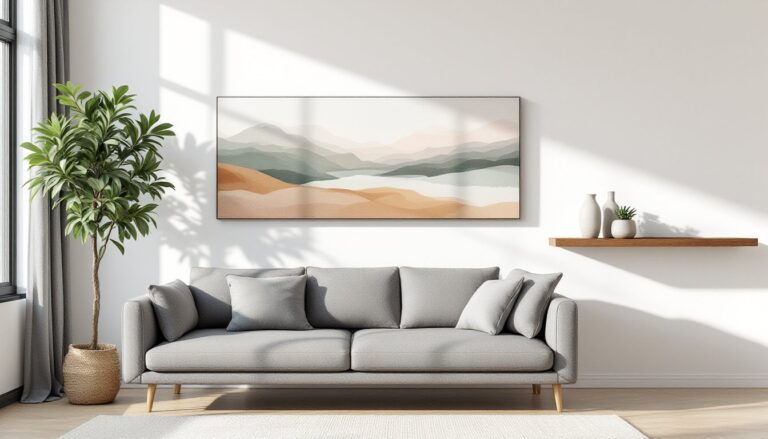
Sometimes a single large piece delivers more impact than a dozen small ones. Oversized art, anything 36×48 inches or larger, anchors a room and provides a ready-made focal point without the layout fuss of a gallery wall.
For renters, the challenge is weight and mounting. A large canvas can weigh 10 to 30 pounds depending on frame material. If using adhesive strips, you’ll need multiple strips rated collectively above the piece’s weight, distributed evenly across the frame’s hanging hardware. Check the manufacturer’s instructions, most require one strip per 4 to 8 pounds of weight.
Alternatively, lean large art against the wall on a console table or directly on the floor. This works especially well with pieces 48×60 inches or bigger. It’s a look popularized by designers and featured frequently on sites like Decoist, where oversized art creates drama without permanent installation.
Tapestries and fabric wall hangings offer another large-scale option. A 5×7 foot tapestry can cover an entire wall and typically weighs under 2 pounds, making it easy to hang with a tension rod, adhesive clips, or even pushpins if small holes are permitted. They also add texture and can soften sound in rooms with hard surfaces.
Safety note: Large, heavy pieces pose a falling hazard if improperly secured. If using nails or screws, find the wall studs with a stud finder and anchor into solid wood, not just drywall. Studs in most apartments are spaced 16 inches on center. If studs don’t align with your desired placement, use drywall anchors rated for the piece’s weight, toggle bolts or molly bolts are reliable for loads over 20 pounds.
Functional Wall Decor: Shelves, Mirrors, and More
Wall decor doesn’t have to be purely decorative. Functional pieces like floating shelves, mirrors, and wall-mounted organizers add visual interest while solving storage and spatial problems.
Floating shelves (typically 24 to 48 inches long and 8 to 12 inches deep) display books, plants, or collections while breaking up empty wall expanses. For renters, adhesive-mounted shelves work for lightweight items (under 5 pounds total load), but anything heavier requires proper anchoring. Screw-mounted shelves should hit at least one stud: for spans between studs, use drywall anchors rated appropriately. A single potted plant in a ceramic pot can easily weigh 8 to 12 pounds, plan accordingly.
Mirrors are workhorses in apartments. A well-placed mirror reflects natural light, making small rooms feel brighter and more open. Oversized floor mirrors (around 65×22 inches) lean against the wall with no mounting required. Wall-mounted mirrors benefit from the same renter-friendly hardware as art: adhesive strips for lighter pieces (under 10 pounds), or anchored screws for heavier framed mirrors.
For those seeking budget-friendly DIY decor projects, pegboard walls offer modular, customizable storage. A 2×4 foot pegboard panel mounts with a few screws (into studs, ideally) and accepts hooks, shelves, and bins that rearrange without tools. Paint the pegboard to match or contrast the wall, it’s a functional statement piece common in home offices and craft spaces.
Corkboard or fabric-covered bulletin boards serve similar purposes. A 3×4 foot corkboard provides space for pinning notes, photos, and inspiration, doubling as texture on the wall. Cover standard corkboard with fabric using a staple gun for a custom look that hides the cork grain.
Installation tip: When mounting shelves or heavy mirrors, pre-drill pilot holes slightly smaller than the screw diameter to prevent drywall crumbling and make driving screws easier. For wood studs, a 1/8-inch pilot bit works well with standard #8 or #10 wood screws.
Budget-Friendly DIY Wall Decor Projects
DIY wall decor stretches budgets and creates one-of-a-kind pieces that can’t be replicated from a store.
Frame inexpensive materials. Wrapping paper, fabric remnants, or pages from old books cost pennies and look striking in coordinated frames. A set of six 8×10 inch frames (around $3-$5 each at discount stores) filled with botanical prints or geometric patterns creates a gallery effect for under $40 total.
Washi tape wall designs require zero tools. This low-tack decorative tape (available in hundreds of patterns) adheres to painted walls and removes cleanly, making it ideal for renters. Use it to create geometric patterns, faux wainscoting, or picture frame outlines directly on the wall. A single roll covers roughly 15 to 20 linear feet, enough for a simple accent design.
Vinyl wall decals work similarly, they’re removable, reusable, and available in everything from typography to full-wall murals. Application is straightforward: clean the wall, peel the backing, smooth the decal with a squeegee or credit card to eliminate bubbles, then remove the transfer tape.
Photo ledge shelves are simple to build. Cut a 1×4 pine board to desired length (48 inches is common), add a 1×2 lip along the front edge with wood glue and brad nails, then mount the assembly to the wall with L-brackets or French cleats. Total material cost runs $10-$15 for a 4-foot ledge. Sand edges smooth and apply paint or stain before mounting.
Safety reminder: When cutting lumber, always wear safety glasses and hearing protection. A circular saw with a guide makes straight cuts, but a hand saw works for small projects if power tools aren’t available.
Pressed botanicals under glass offer an organic, budget-friendly option. Press leaves or flowers between heavy books for 1 to 2 weeks, then arrange them in floating frames (two panes of glass held together with clips). The result is a minimalist, airy piece that costs virtually nothing aside from the frame.
For those willing to invest a bit more, DIY canvas art using acrylic paint on pre-stretched canvas panels (available in sizes from 8×10 to 24×36 inches, costing $5-$20 depending on size) allows for fully custom pieces. Abstract designs require no drawing skill, bold color blocks, drips, or textured applications with palette knives all produce gallery-worthy results.
Conclusion
Transforming apartment walls doesn’t require a contractor or a forfeited security deposit. With renter-friendly hardware, thoughtful planning, and a willingness to experiment, even the most restrictive lease can accommodate personal style. Whether it’s a carefully curated gallery wall, a single statement piece, or a functional shelf display, the right wall decor turns a generic rental into a space that actually feels like home.