Table of Contents
ToggleThe wall behind a bed is prime real estate, it’s the first thing you see when you walk into a bedroom, and it anchors the entire space visually. Yet many homeowners leave it blank or slap up a single piece of art without considering scale, proportion, or installation method. Done right, above-the-bed decor can add depth, texture, and personality. Done poorly, it reads as an afterthought or creates a top-heavy look that throws off the room’s balance. This guide walks through seven approaches that work, from classic framed art to architectural features, with practical tips on sizing, hanging hardware, and avoiding common mistakes.
Key Takeaways
- Above the bed wall decor serves as a crucial focal point that defines the room’s style and visual balance—aim for pieces at least 40–48 inches wide for a queen-size bed and maintain 6–12 inches of clearance from the headboard.
- Classic framed art and canvas prints remain the most popular option; use picture-hanging hooks rated for weight or wall anchors rated for heavy pieces, and always use a stud finder first for the most secure installation.
- Statement headboards—upholstered, reclaimed wood, or painted geometric shapes—can eliminate the need for separate wall decor while adding texture and personality to your bedroom.
- Textural elements like tapestries, macramé, and woven hangings add warmth and sound dampening but require protection from direct sunlight to prevent fading.
- Gallery walls and photo collages offer flexibility and personalization, working best with 2–3 inches of spacing between frames and a common design thread across mixed frames.
- Architectural accents such as mirrors, floating shelves, and wood paneling add both function and visual interest, requiring secure stud mounting or heavy-duty anchors to ensure safety and durability.
Why the Space Above Your Bed Matters
The wall above a bed functions as the room’s focal point, similar to how a fireplace mantel or a large window draws the eye in other spaces. Because most beds sit centered on a wall, whatever hangs above them sets the tone for color palette, style, and formality.
From a design standpoint, this wall offers vertical space that balances the horizontal mass of the bed and nightstands. Left empty, the room can feel unfinished or visually bottom-heavy. Overloaded with decor, it can feel cluttered or unsafe, especially if hanging hardware isn’t rated for the weight.
Practically, this is also a wall you’ll see while lying in bed, so consider how it reads from that angle. A piece hung too high looks disconnected from the headboard. Too low, and it risks getting knocked by pillows or heads. The rule of thumb: leave 6 to 12 inches of clearance between the top of the headboard (or mattress, if there’s no headboard) and the bottom of the decor. For large-scale pieces, aim for the center of the art to sit at roughly 57 to 60 inches from the floor, standard gallery height.
Classic Wall Art and Canvas Prints
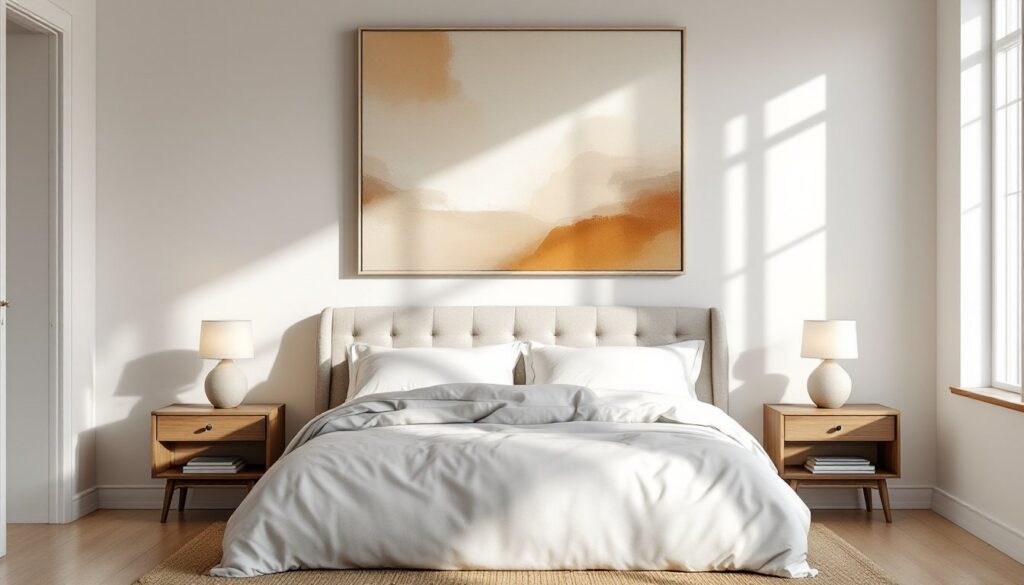
Framed prints, canvases, and posters remain the most straightforward option. They’re widely available, easy to swap out, and don’t require specialized tools beyond a drill, level, and the right wall anchors.
Sizing matters. A common mistake is choosing art that’s too small. For a queen-size bed (60 inches wide), aim for a single piece that’s at least 40 to 48 inches wide, or a diptych/triptych set that spans a similar range. For a king (76 inches), go wider, 50 to 60 inches, or use a grouping of smaller frames.
Hanging hardware: Canvas prints often come with sawtooth hangers or wire, which are fine for lightweight pieces (under 10 lbs). For anything heavier, like a large framed print with glass, use picture-hanging hooks rated for the weight, or install wall anchors (toggle bolts or molly bolts) if you’re not hitting a stud. Always use a stud finder first: hitting solid wood is the most secure option.
Frame choice: Wood frames suit traditional or rustic interiors, while metal or acrylic frames lean modern. Float frames, where the canvas appears suspended inside the frame, add depth and work well in contemporary spaces. Skip ornate frames with heavy matting unless the room already has formal details like crown molding or wainscoting.
One pro tip: if you’re renting or want flexibility, try Command picture-hanging strips rated for your art’s weight. They hold surprisingly well on drywall and come off clean, though they’re not ideal for textured walls or high-humidity rooms.
Statement Headboards as Decorative Focal Points
A tall, visually striking headboard can eliminate the need for separate wall decor entirely. Upholstered headboards with tufting or nailhead trim, reclaimed wood planks arranged vertically, or a painted accent wall paired with a minimal frame all serve as built-in focal points.
Upholstered options: Fabric headboards in velvet, linen, or performance fabric (easier to clean) add softness and sound dampening. Many DIYers build their own by cutting ½-inch plywood or MDF to size, wrapping it in 2-inch foam and fabric, then mounting it to the wall with French cleats or Z-clips. This method keeps the headboard off the floor, simplifies cleaning, and distributes weight across studs.
Wood headboards: Reclaimed barn wood, shiplap, or even 1×6 pine boards stained and mounted horizontally create texture without adding bulk. If going this route, acclimate the wood indoors for 48 to 72 hours before installation to prevent warping. Secure each board to wall studs with 2½-inch wood screws countersunk and filled, or use construction adhesive plus finish nails for a cleaner look (though adhesive makes future removal trickier).
Painted shapes: For a budget-friendly statement, paint a geometric shape, arch, rectangle, or half-circle, directly on the wall behind the bed using painter’s tape and a mini roller. Use low-VOC or zero-VOC interior paint in an eggshell or satin finish for easy cleaning. This approach works especially well in kids’ rooms or rental spaces where you can repaint before moving out.
Textural Elements: Tapestries, Macramé, and Woven Wall Hangings
Textile-based decor adds warmth and softens sound, which is a bonus in bedrooms with hard flooring or minimal soft furnishings. Tapestries, macramé panels, and woven wall hangings introduce organic texture without the heft of wood or metal.
Tapestries: Available in countless patterns and sizes, tapestries typically hang from a wooden dowel or curtain rod. To hang, mount rod brackets to wall studs or use drywall anchors rated for the fabric’s weight (most tapestries are under 5 lbs). Leave the dowel extending 2 to 4 inches beyond each side of the fabric for a finished look. For a modern take, some homeowners frame tapestries in simple wood frames or mount them on stretcher bars like canvas.
Macramé: These knotted fiber pieces range from delicate boho designs to chunky, sculptural hangings. Because macramé is lightweight, a single finish nail or small hook often suffices. Be aware that macramé collects dust, vacuum it gently with a brush attachment every few weeks, or take it outside and shake it out.
Woven hangings: Jute, wool, or cotton weaves in neutral tones suit minimalist or Scandinavian-style rooms. Many feature built-in dowels or leather loops for hanging. If the piece is handmade or vintage, check for moth damage or loose threads before hanging, especially if it’s been stored.
One caveat: textiles can fade in direct sunlight. If the bed wall faces a large window, consider UV-filtering window film or blackout curtains to protect the piece. Recent interior design trends have highlighted the durability of budget home makeovers that incorporate textiles strategically.
Gallery Walls and Photo Collages
Gallery walls offer flexibility and personalization, but they require more planning than a single large piece. The payoff is a custom arrangement that can evolve over time.
Layout first, holes second: Lay out frames on the floor or tape paper templates to the wall before drilling. Aim for 2 to 3 inches of spacing between frames for a cohesive look, too tight feels crowded, too loose reads disconnected. For a grid layout, use a laser level or chalk line to ensure rows are straight. For an organic salon-style wall, start with the largest piece near center-left (about 6 inches left of dead center) and build outward.
Frame uniformity: Matching frames in the same color or finish create a unified look, even with varied art. Mismatched frames work if there’s a common thread, same mat color, similar proportions, or a shared palette. Black, white, natural wood, and gold are the easiest to mix.
Hanging hardware for multiples: For heavy frames, use 2-hole D-rings with wire, which distribute weight better than sawtooth hangers. Install a small level on each frame before marking the wall. For lightweight frames, adhesive strips or small nails work fine.
Photo collages: Printed family photos, travel shots, or black-and-white portraits add a personal touch. Print on archival paper if you want them to last, and consider UV-protective glass or acrylic if the wall gets sunlight. Online services offer custom grid layouts with identical frames shipped ready to hang, which simplifies the process.
Gallery walls pair especially well with neutral bedding and minimal furniture, where the wall becomes the room’s personality. Designers often reference approaches from sources like MyDomaine when curating balanced arrangements.
Architectural Accents: Mirrors, Shelving, and Wood Panels
For rooms that need more than decoration, think small spaces or rentals with bland walls, architectural elements add function and visual interest.
Mirrors: A large mirror (or grouping of smaller ones) reflects light and makes a room feel bigger. Frameless mirrors suit modern spaces: ornate frames work in traditional settings. Mount mirrors securely, mirror clips or J-channels work for frameless models, while framed mirrors need heavy-duty wall anchors or stud mounting. Never hang a heavy mirror above a bed with only adhesive: if it falls, it’s a safety hazard.
Floating shelves: 2 to 3 shallow shelves (6 to 8 inches deep) mounted above the bed can hold plants, books, or small decor items. Use hidden bracket systems (like Shaker pegs or internal supports) for a clean look. Secure shelves to studs with 3-inch screws, especially if you plan to load them with books. Avoid placing anything breakable directly above the pillow zone.
Wood paneling: Board-and-batten, picture frame molding, or simple 1×4 trim arranged in geometric patterns adds depth and character. Paint the panels the same color as the wall for subtle texture, or use a contrasting shade for definition. Install over drywall using a brad nailer and construction adhesive, then fill nail holes and caulk seams before painting. This treatment works particularly well in homes with plain drywall and no existing trim details. When planning accent walls, exploring resources like home gym wall decor can spark ideas for functional yet stylish treatments.
Plate rails or picture ledges: Narrow ledges let you rotate art or decor seasonally without new holes in the wall. Mount with the same care as shelves, studs preferred, heavy anchors if not. Popular options include IKEA Mosslanda ledges or DIY versions built from 1×2 pine with a small lip.
Architectural treatments often require more commitment than swappable decor, but they add lasting value and appeal, especially if you’re planning to stay in the home long-term. Many bedroom design guides, including those from House Beautiful, emphasize the impact of three-dimensional wall treatments.
Conclusion
The wall above a bed isn’t just empty space, it’s an opportunity to define the room’s style, improve its proportions, and make the space feel intentional. Whether it’s a single oversized canvas, a textured headboard, or a curated gallery wall, the key is proper sizing, secure installation, and honest assessment of your DIY comfort level. Don’t skip the stud finder, and don’t hang anything heavy with command strips alone. Take the time to plan, measure twice, and your bedroom will look pulled together instead of pieced together.